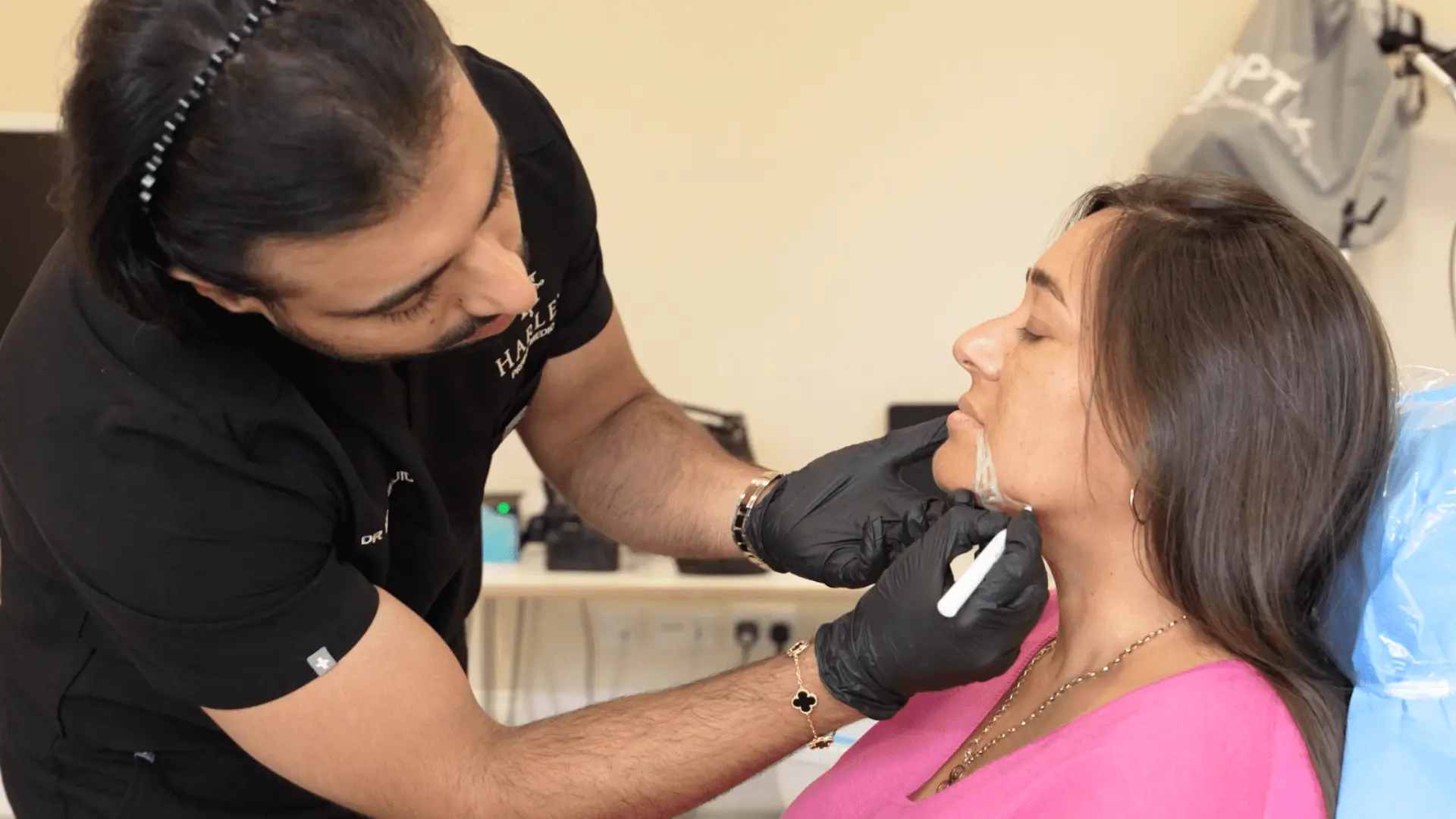
What is PRP hair treatment?
PRP hair treatment is a non-surgical procedure that uses platelet-rich plasma prepared from a small sample of your own blood. The plasma is injected into areas of thinning hair with the aim of supporting existing follicles and encouraging healthier growth. Research suggests PRP may improve hair density in some people with pattern hair loss, although results vary and a course of treatment is usually required.
Hair thinning can have several possible causes, which is why an accurate assessment matters. At Harley Private, Dr Isran Sajid assesses the pattern and history of hair loss before recommending a personalised plan. Where appropriate, this can incorporate photobiomodulation, a form of controlled red or near-infrared light therapy.
What does PRP stand for?
PRP stands for platelet-rich plasma. Platelets are components of blood best known for their role in clotting, but they also contain signalling proteins known as growth factors. These are involved in normal tissue repair and communication between cells.
During PRP hair treatment, a small blood sample is taken from your arm and placed in a centrifuge. This separates the blood into its different components and allows the platelet-rich portion of the plasma to be collected. The prepared PRP is then injected in small amounts across the areas of the scalp being treated.
Although treatment uses your own blood, it remains a medical procedure requiring proper assessment and sterile clinical technique.
How does PRP hair treatment work?
Hair follicles naturally cycle through phases of growth, transition and rest. In androgenetic alopecia—more commonly called male or female pattern hair loss—susceptible follicles gradually become smaller and produce finer, shorter hairs. The British Association of Dermatologists describes this process as follicular “miniaturisation”.
PRP is thought to deliver a concentrated mixture of platelet-derived signals around functioning but weakened follicles. These signals may help support the follicle environment, prolong the active growth phase and improve the diameter or density of existing hair. PRP cannot create entirely new follicles, and it is unlikely to restore hair in an area where follicles are no longer active.
A systematic review indexed by PubMed found that PRP has shown potential in androgenetic alopecia, but preparation and treatment methods differ between studies. Outcomes therefore cannot be guaranteed.
Who may be suitable for PRP hair treatment?
PRP may be considered for men and women experiencing early or moderate hair thinning, particularly where follicles are still present. It may be suitable for:
- Male or female pattern hair loss
- Gradual thinning across the crown or parting
- A receding hairline where viable follicles remain
- People seeking a non-surgical treatment option
- Selected patients who want to support hair quality before or after a transplant
It is not appropriate for every type of hair loss. Sudden shedding, smooth bald patches, scalp inflammation, illness, medication, nutritional deficiency or hormonal changes may require investigation. PRP may also be unsuitable with certain blood or platelet disorders, active infection, some scalp conditions or particular medications. Blood tests or referral may sometimes be advised.
What happens during a PRP hair treatment appointment?
Your consultation covers how the hair loss has progressed, relevant medical and family history, medication and previous treatment. The scalp and pattern of thinning are also assessed. If PRP is suitable, an appointment involves:
- Blood collection: A small sample is taken from your arm.
- PRP preparation: The sample is processed in a centrifuge to isolate the platelet-rich plasma.
- Scalp treatment: The scalp is cleansed and PRP is delivered through a series of precise, shallow injections.
- Photobiomodulation: Where included in the plan, controlled light therapy is applied to the treatment area.
- Aftercare: You receive guidance on washing, exercise, products and other hair-loss treatments.
Why combine PRP with photobiomodulation?
Photobiomodulation uses specific wavelengths of red or near-infrared light at a controlled dose. It is also described in hair-loss research as low-level light or laser therapy. Unlike heat-based lasers, it is designed to influence cellular activity without deliberately damaging the skin.
Light absorbed by cells may support cellular energy production and signalling around the follicle. A systematic review and meta-analysis reported improvements in hair density in androgenetic alopecia, while noting differences between devices and treatment parameters.
At Harley Private, photobiomodulation complements Dr Isran’s PRP protocol where appropriate. The two treatments offer different stimuli to the scalp, but combining them cannot guarantee an outcome. The British Association of Dermatologists notes that research into both PRP and low-level light therapy is still developing.
How many PRP sessions are needed?
PRP is normally planned as a course. The number and spacing of sessions depend on the diagnosis, extent of thinning and response. Maintenance may be discussed because pattern hair loss is progressive. Consistent photographs help track gradual change.
When will I see results from PRP hair treatment?
PRP does not produce instant growth. Some patients first notice reduced shedding or changes in hair quality, with visible improvement potentially developing over several months. Response varies considerably, and some people obtain little or no measurable benefit.
Results depend on the cause and duration of hair loss, viable follicles, health and treatment consistency. PRP is not a cure or a replacement for every medical or surgical option.
Is PRP hair treatment painful, and is there downtime?
You will feel a needle during both the blood draw and scalp injections. Most patients describe temporary pinching, pressure or tenderness rather than prolonged pain. Comfort measures can be discussed during consultation.
Common short-term effects may include:
- Redness or pinpoint bleeding
- Mild swelling, tenderness or tightness
- Headache or scalp sensitivity
- Temporary bruising or itching
These effects usually settle. Less common risks include infection, prolonged inflammation, injury and scarring. Contact the clinic if symptoms are severe, worsening or unexpected.
Can PRP be combined with other hair-loss treatments?
Yes, but the combination depends on the diagnosis. PRP and photobiomodulation may sit alongside topical or prescription treatment, nutritional correction or transplant planning. Minoxidil and finasteride are established options for certain patients, but have suitability considerations and potential side effects. The plan should match the cause of hair loss, health and patient preferences.
Why choose Dr Isran Sajid for PRP hair treatment?
PRP involves blood collection, clinical preparation and multiple scalp injections. Dr Isran Sajid is a GMC-registered medical doctor who takes a patient-specific approach to assessment, consent and follow-up. His protocol can incorporate photobiomodulation where appropriate, offering a broader approach than PRP injections alone while maintaining honest expectations.
PRP hair treatment FAQs
Does PRP hair treatment really work?
Research suggests PRP can improve hair density or thickness in some people with androgenetic alopecia. However, results vary, study protocols are inconsistent and it does not work for everyone. A consultation is needed to judge whether your follicles and type of hair loss are likely to respond.
Is PRP hair treatment permanent?
No. PRP does not cure the underlying tendency to pattern hair loss. An initial course and ongoing maintenance may be recommended, and other treatments may also be required to preserve results.
Can PRP regrow hair on a completely bald scalp?
PRP aims to support existing follicles; it cannot manufacture new ones. It is generally more appropriate for thinning areas where follicles remain than smooth areas of longstanding, complete hair loss.
Is PRP hair treatment safe?
PRP uses plasma prepared from your own blood, which reduces the risk of an allergic reaction to the injected material. Injection-related risks still exist, including discomfort, bleeding, bruising and infection. Suitability screening and sterile medical technique are important.
What is photobiomodulation for hair loss?
Photobiomodulation is a non-invasive treatment using controlled red or near-infrared light. It aims to support cellular activity around the hair follicle. Evidence is promising for pattern hair loss, although the device, wavelength, dose and treatment consistency can influence outcomes.
Can women have PRP hair treatment?
Yes. Women with suitable forms of thinning may be considered for PRP. Because female hair loss may have hormonal, nutritional or medical causes, assessment and any necessary investigation are particularly important.
Should I stop minoxidil or other medication before PRP?
Do not stop prescribed or established hair-loss treatment without medical advice. Dr Isran will review your medication and give instructions based on your individual treatment plan.
Book a PRP hair treatment consultation
If you are concerned about thinning hair, the first step is understanding what may be causing it. Book a consultation with Dr Isran Sajid at Harley Private for a medically led assessment and a personalised discussion of PRP hair treatment, photobiomodulation and any other appropriate options.
This article is for general educational purposes and does not replace individual medical advice. Treatment suitability, risks and expected outcomes are discussed during consultation.
References
- British Association of Dermatologists. Hair loss: male pattern (androgenetic alopecia).
- Evans AG et al. The role of platelet-rich plasma in androgenetic alopecia: a systematic review. Journal of Cosmetic Dermatology.
- Liu Y et al. Photobiomodulation therapy with different wavebands for hair loss: a systematic review and meta-analysis. Dermatologic Surgery.
- British Association of Dermatologists. Male pattern hair loss patient information leaflet, June 2024.